Showing posts with label hope for the future. Show all posts

Friday, February 13, 2015

Why has crime declined?

We don't know exactly why, but we're pretty sure that high incarceration rates didn't do it. [Link]
But if it was not incarceration, then what did cause the crime decline?
There is no shortage of candidates. Every year, it seems, a new study advances a novel explanation. Levitt attributes about half the crime drop to the legalization of abortion. Amherst economist Jessica Reyes attributes about half the violent crime drop to the unleading of gasoline after the Clean Air Act. Berkeley law professor Franklin Zimring credits the police as the central cause. All three theories likely played some role.
Instead of a single, dominant cause, our research points to a vast web of factors, often complex, often interacting, and some unexpected. Of the theories we examined, we found the following factors had some effect on bringing down crime: a growth in income (5 to 10 percent), changes in alcohol consumption (5 to 10 percent), the aging population (0 to 5 percent), and decreased unemployment (0 to 3 percent). Policing also played a role, with increased numbers of police in the 1990s reducing crime (0 to 10 percent) and the introduction of CompStat having an even larger effect (5 to 15 percent).
But none is solely, or even largely, responsible for the crime drop. Unfortunately, we could not fully test a few theories, as the data did not exist at the detailed level we needed for our analysis. For those, we analyzed past research, finding that inflation and consumer confidence (individuals’ belief about the strength of the economy) probably had some effect on crime. The legalization of abortion and unleading of gasoline may also have played some role.
In aggregate, the fourteen factors we identified can explain some of the drop in crime in the 1990s. But even adding all of them together fails to explain the majority of the decrease.

Thursday, December 11, 2014

Standing on the shoulders of giants

In this case, those shoulders are a little smaller, but no less impressive. [Link]
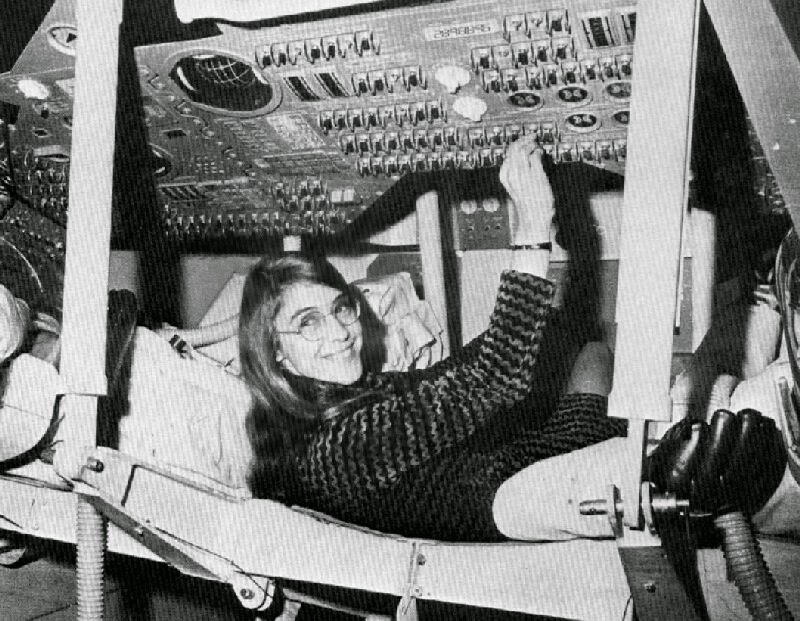
Margaret Hamilton earned her BA in math from Earlham College, but obviously learned about programming on the job—there was no other way. In the photo above, she is standing in front of the printouts of the code for the Apollo guidance system, a lot of which she wrote and which she oversaw.
She was all of 31 when the Apollo 11 lunar module landed on the moon, running her code. (Apollo 11 was able to land at all only because she designed the software robustly enough to handle buffer overflows and cycle-stealing.)
She’s now a tech CEO and won the ‘86 Lovelace Award and the NASA Exceptional Space Act Award.
The engineers weren’t all boys with crewcuts, short sleeve oxford shirts, and narrow black ties. That’s just a fairy tale they told for a while.
Her Wikipedia Entry.
At NASA Hamilton was responsible for helping pioneer the Apollo on-board guidance software required to navigate to/from and land on the moon, and its multiple variations used on numerous missions (including the subsequent Skylab).[1] She worked to gain hands-on experience during a time when computer science and software engineering courses or disciplines were non-existent.
In the process, she produced innovations in the fields of system design and software development, enterprise and process modelling, preventative systems design, development paradigm, formal systems (and software) modelling languages, system-oriented objects for systems modelling and development, automated life-cycle environments, methods for maximizing software reliability and reuse, domain analysis, correctness by built-in language properties, open-architecture techniques for robust systems, full life-cycle automation, quality assurance, seamless integration (including systems to software), distributed processing systems, error detection and recovery techniques, man/machine interface systems, operating systems, end-to-end testing techniques, and life-cycle management techniques.[1]
These in turn led her to develop concepts of asynchronous software, priority scheduling, and man-in-the-loop decision capability, which became the foundation for modern, ultra-reliable software design.


Tuesday, August 12, 2014

A better world?

A might have been if Hillary had won instead of Obama. [Link]
Well, Kevin Drum tickled my counterfactual fancy this morning with the following aside: “I don't have any problems with Hillary's domestic policy. I've never believed that she 'understood' the Republican party better than Obama and therefore would have gotten more done if she'd won in 2008, but I don't think she would have gotten any less done either. It's close to a wash.”
I’m actually going to disagree a bit here. I think that Hillary Clinton would have been more cautious when dealing with Republicans, and therefore ultimately more successful in some ways. At the very least, she would not be facing the same level of vehement opposition in Congress.
I think liberals really do not understand emotionally the extent to which the Tea Party was created by the Affordable Care Act and the feeling that its government was simply steamrolling it. From the Tea Party's perspective, you had an unpopular program that should have died in the same way, and for the same reasons, that Social Security privatization did: because sensible politicians saw that, no matter how ardently they and their base might desire it, this was out of step with what the majority of the country wanted (and no, you cannot rescue the polls by claiming that the only problem with the law was that it wasn’t liberal enough; when you dig down into what people mean when they say that, the idea that there was ever a majority or a plurality that was secretly in favor of Obamacarecollapses).
The rage was similar to what progressives felt as they watched George W. Bush push the country into a war in Iraq. That defined and animated the anti-war movement (which is why said movement collapsed when Bush left office, and not, say, when Bush agreed to a staged withdrawal of our forces). Yes, those people would still have hated Republicans, even if there had been no Iraq War. But they would not have been as passionate, as organized or as powerful without it.
Liberals tend to write off this anger as racism, as irrational hatred of Barack Obama, or as perverse joy in denying health care to the poor, but at its root, it’s the simpler feeling that your country is making a mistake and you can’t stop it because the people in charge are ignoring the obvious. Yes, a lot of money and energy was poured into the Tea Party by rich backers, but rich backers cannot create a grassroots campaign unless the underlying passion is there in the voters (paging Karl Rove and Crossroads). The Obama administration created that passion with Obamacare.
I think that Hillary Clinton would have pulled back when Rahm Emanuel (or his counterfactual Clinton administration counterpart) told her that this was a political loser and she should drop it. I’ve written before about how my Twitter feed filled up with comparisons to 1932 the night that Obama took the presidency, and it’s quite clear to me that the Obama administration shared what you might call delusions of FDR. It thought that it was in a transformative, historical moment where the normal rules of political caution didn’t apply. The administration was wrong, and the country paid for that.
That’s not to say that Republicans would have somehow been all kissy-kissy with Clinton -- they weren’t very nice to her husband, after all. She would of course still have faced stiff opposition in Congress, because the partisan divide in this country is getting wider and congressional districts are getting more polarized, which makes it harder and harder to do deals across the aisle, or even treat each other with a modicum of decency. But I doubt she would have had the debt ceiling debacle or the deep gridlock of the last four years, because it was Obamacare that elected a fresh new class of deeply ideological Republicans who thought they were having their own transformative political movement, and they were willing to do massive damage to their party, their own political fortunes and, in my opinion, to the country in order to take a stand against “business as usual” -- business that included legislating or paying our bills.
Of course, in my counterfactual, Hillary also probably wouldn’t have proposed ambitious health-care reform; she’d have done something more modest, like a Medicaid expansion. Progressives might well say that they’d rather have the first two years of the Obama administration, followed by gridlock, than steadier but more modest achievements by a Hillary Clinton administration. And that doesn’t even get us into foreign policy, where the differences were deeper and more passionate.

Tuesday, June 24, 2014

No-fly list unconstitutional

This is good news, at least as long as it lasts. I expect it to be reversed or ignored. How cynical is that? [Link]
The U.S. government offers no adequate method for people to challenge their placement on its no-fly list, a federal judge ruled Tuesday in a case involving 13 Muslims who believe they're on the list.
U.S. District Court Judge Anna Brown found people lack a meaningful way to challenge their placement on the list, which bars them from flying to or within the United States. She also said the 13 people who sued the government have been unconstitutionally deprived of their right to fly.
"This should serve as wakeup call to the government," said American Civil Liberties Union attorney Hina Shamsi. "This decision also benefits other people wrongly stuck on the no-fly list because it affords them (an opportunity to challenge) a Kafkaesque bureaucracy."
U.S. Justice Department spokeswoman Dena Iverson said government attorneys were reviewing the decision.
Thirteen people — including four military veterans — challenged their placement on the list in 2010.
Initially, Brown said she couldn't rule on the case. In 2012, the 9th U.S. Circuit Court of Appeals disagreed and sent the case back to her. Brown ruled in August that the 13 people challenging their presence on the list had a constitutional right to travel and, on Tuesday, found the government violated that right.

Sunday, June 01, 2014

Good news in Iraq

Nice. [Link]
It is a conversation, in other words, about government formation in a functional, stable, and constitutional electoral setting. There is no talk of coups, of disenfranchised minorities, or politicized electoral commissions. The process of forming the next government may take months, and current Prime Minister Nouri al-Maliki is the front-runner, although his victory is far from certain. Whoever does emerge atop what Disraeli called the “greasy pole”, there is no chance of a government that harbors al-Qaeda or belongs to the mullahs in Tehran, that invades its neighbors, assassinates its enemies, or gasses its own people. All of these things are vote-losers in Iraq, and in Iraqi politics today it is the vote that matters most.
Well… yes, of course. That often happens when you take over a country for ten years and shoot every stupid son-of-a-bitch who prefers to solve his problems with an AK-47 or an IED.  Look, I don’t pretend to understand the process where American occupation / long-term presence somehow transforms various autocratic states into places like Japan and Germany and South Korea.  Maybe it’s our attitude.  Maybe it’s a ritual magic spell.  Maybe there’s bacteria in our bodies that generate liberty and democracy, and when enough GIs excrete in one place they ‘contaminate’ the local ecosystem*.  Whatever the method is, it works. And it’s apparently kind of independent of whoever is running the USA at any given moment, which is frankly a bit of a relief.


Wednesday, April 09, 2014

The Muppets and Generation X

We were molded by Jim Henson and that's a good thing. [Link]
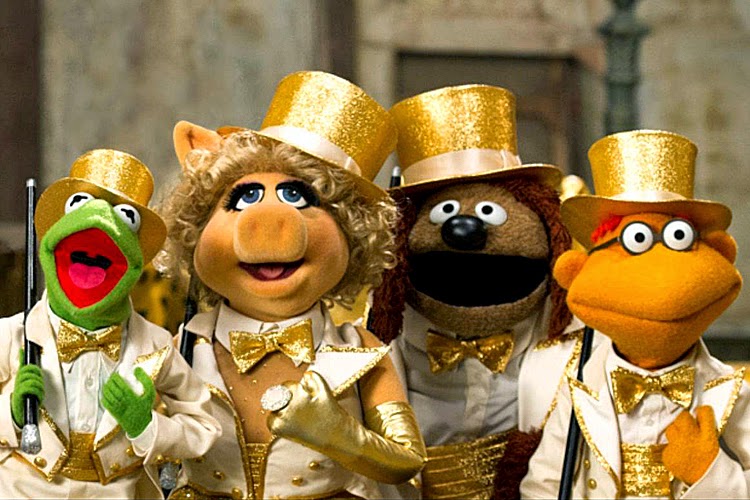
Disney’s “Muppets Most Wanted” was released late last month, and despite reviews presaging disappointment, America took to their theaters to see how the latest installment of karate chops and sight gags would fare. Whether you’re a purist who can’t stand “wrong Muppet voices” or an overjoyed muppet-man, either way you care about Kermit. While most journalists are covering the Muppets from the angle of “did they live up to Jim Henson’s standard?” this isn’t that kind of article. What I want to know is – why do we care so goddamn much. We’re grown-ups. Why is this still so important to us?
In the lead-up to the Bobin-Stoller-helmed Muppet film, we’ve been seeing a good deal of googley-eyes, fleece and flocked foam. (Contrary to popular opinion, Muppets are not made of felt.) In February, the Electric Mayhem – the Muppet Show’s raucous house band – spiced up the categorically “sensible” Toyota brand playing “No Room for Boring” in a well-received Super Bowl ad. Soon after, they played a soulful rendition of “The Weight” with Jimmy Fallon to mark the end of “Late Night,” a resonant moment, for what was effectively an NBC studio swap. Lipton and Subway ads followed, incurring Twitter backlash. Last fall, Lady Gaga and the Muppets performed a well-intentioned Thanksgiving special on ABC that no one liked. The reason for this upswing in Muppets is obvious: Disney has launched a concerted publicity campaign for its new film property. But that’s not the half of it.
Lately, spontaneous references to Jim Henson and his creations have also cropped up. On “The Mindy Project”: “I will Jim Henson you into apologizing.” On “Community”: “Welcome to the Labyrinth, kid, only there ain’t no puppets or bisexual rock stars.” Comedian Mike Birbiglia has been riffing on “The Muppet Show” in his live act: telling the story of the time Statler and Waldorf heckled him on-stage. Unless this is the next phase of insidious product placement, it seems that the Muppets don’t exactly need Disney’s push. Thirty- and 40-somethings, once reminded, seem to be generating their own buzz, and this buzz was brought to us by the letter N. N, of course, is the first letter in the word “nostalgia.”
We – adults – love the Muppets. Boomers remember “The Muppet Show” as one of the rare shows they could watch with their children that didn’t make them sick. Some millennials remember “Muppet Babies” while most are coming to the franchise with fresh curiosity. But the generation that is most attached to the Muppets is surely Generation X; for adults of a certain age, the Muppets make us nostalgic for our youth in the ’70s and ’80s. Though it was a time of economic trouble, nuclear threat and increasing divorce rates, it was also a time of arcades, station wagons and playing in the streets without parental supervision.
It would be wrong to say, “Everyone in Generation X loves the Muppets,” yet it’s so right-esque that when people do not like Muppets, they feel compelled to justify it in Op-Ed pieces. But if you search “don’t like the Muppets” on Twitter, you’ll find tweets making it very clear that someone who doesn’t get the Muppets just can’t be trusted.
The Muppets are a touchstone for a generation of middle-aged Americans, and I agree I’m probably more nostalgic than a grown adult should be. (I published a book about Henson this month, after researching his business for the last three years.) But it’s not just me. It’s crazy what a lasting legacy one puppeteer – Jim Henson – has had. And how many people feel genuinely emotional about his characters, nearly 25 years after his death.
So what’s the reason for our collective nostalgia? Is it simply his ubiquity in our childhoods? Is it simply the case that whatever you put in front of a child will become meaningful to him or her? Television has become a kind of de facto baby sitter, a virtual mentor and best friend to the developing child. A college freshman might feel just as emotional about Barney, Power Rangers and the Teletubbies. While I don’t have a high opinion of the lobotomized purple dinosaur, he was certainly a “touchstone” to 20-year-olds.
We all have our nostalgia. But, at least for me, my love of Henson’s work goes beyond that. I don’t think we love the Muppets simply because they came from our childhood. We love the Muppets because they gave us a worldview – a profoundly idealistic, yet profoundly realistic worldview – that many of us carry into our adulthoods. It is only rarely that we take the time to consider where we picked up such ideas.
Not all Generation Xers are intent on “making the world a better place,” but a good deal are. And even with the Howard Roarks of Xers, the Donald Trumps of our cohort, there is one abiding similarity: Big Bird. For those born from the mid-’60s to the mid-’80s, the first show you probably watched was “Sesame Street.” I would guess you don’t remember watching it as a 2-year-old, but at that age, you were constantly learning about the world, and like a sponge, you took it all in.

Friday, March 21, 2014

Routing around censorship

The internet in action. Go Turks! [Link]
Over the last few weeks we've discussed a few times how Turkish Prime Minister Recep Tayyip Erdogan wanted to ban Twitter. If you don't follow the details of what's happening in Turkey, Zeynep Tufecki has a great backgrounder piece in the NY Times. Either way, the threats became reality, as Erdogan flat out announced his intent was to "eradicate Twitter" and also:
I don't care what the international community says. Everyone will witness the power of the Turkish Republic
Turkish ISPs followed the orders to block Twitter, but so far, it's not the power of the Turkish Republic we're seeing, but the power of people and technology to route around attempts at censorship. Many people quickly turned to VPNs or realized that they could still Tweet via text message... or that they could use alternative DNS providers. In fact, it's reached such a level that there's graffiti on the walls in Turkey pointing to Google's DNS which lets users route around the Twitter block:
And it appears that the people are winning so far, as Turkish Twitter users are still tweeting at quite a rapid rate. 


Tuesday, February 11, 2014

Guaranteed Basic Income

I think this may be a good idea. [Link]
Activists in Europe, most notably in Switzerland, have succeeded at injecting the idea into mainstream political debate. A recent poll showed that it has the support of nearly half of Canadians. The president of Cyprus says he’ll launch a limited version of the scheme this summer. Brazil has been giving direct cash transfers to poor families ever since passing a basic income law in 2004; pilot programs have in recent years been carried out in India and Namibia.
In the United States, the idea of handing out unconditional government allowances is seen, understandably, as a nonstarter, despite enjoying some recent buzz among policy wonks. If nothing else, in today’s political environment, it just sounds too much like a socialist fantasy. But the idea has a deep legacy in the United States that almost uniquely stitches together figures on the left and right: Its prominent supporters have included Martin Luther King Jr. and John Kenneth Galbraith, and a version initially suggested by free-market economist Milton Friedman nearly became law under President Nixon. Recently, conservatives like Veronique de Rugy, a senior research fellow at George Mason University’s Mercatus Center, and Charles Murray, author of “The Bell Curve” and a scholar at the American Enterprise Institute, have stepped forward to support the idea; it’s also been embraced by the “Occupy”-affiliated academic David Graeber.
“You usually don’t have people from different ends of the political spectrum getting on board with the same sort of program,” said Brian Steensland, an associate professor of sociology at Indiana University and the author of the book “The Failed Welfare Revolution,” about how basic income went from being a marginal academic idea to a congressional bill and back again. “There’s just something in there that’s really appealing for people from a whole range of intellectual, philosophical, and economic perspectives.”
For pragmatists on the left, cash payments to all would be the fastest way to eradicate poverty, by making sure everyone, no matter their circumstances, has enough money to live on. For the utopian-minded, it holds the promise of a liberation from work—a way to make sure that the next John Lennon doesn’t have to waste all his time lifting boxes in a warehouse. For conservatives, it is a tool for rebuilding the bonds of civil society, putting people’s fortunes back in their own hands, and wiping out the messy, piecemeal, nanny-state safety net in one swoop.
At the moment, the idea is widely seen as too radical a departure from the status quo. Working out the mechanics would be a nightmare, and even that 8-year-old might suspect—rightly—that some people would just give up working. But even if the idea isn’t politically feasible in the short term, its proponents see it as the kind of deep-seated rethinking that may soon be needed to face a problem that doesn’t have an easy solution in our current system: that as technology, outsourcing, and other structural shifts transform our economy, it’s becoming increasingly clear that national prosperity does not necessarily mean there are enough good jobs for everyone who needs one.
In that light, the viability of a solution like the guaranteed basic income—and whether it can be made palatable to Americans for whom work ethic is a prized national value—ends up coming down less to politics than to the fundamental question of how we see the role of work both in the lives of individuals and in society as a whole.


Tuesday, February 04, 2014

A good start

This bad cop fired. Too bad he will almost certainly be rehired by another police department where he can abuse his authority and if called on it, lie about it. [Link]
"Your ill-advised actions also play to some of the most basic fears among some citizens, which is that a police officer may indiscriminately exercise his or her power in violation of their rights," Urquharts discipline letter continues. He explains people fear that "in the event of a complaint, the officer will just deny the allegations and 'circle the wagons' with his or her fellow officers with the expectation they will take care of their own. In a matter of minutes, your actions violated the trust that we, as a department, spend years trying to build and maintain."
Saulet and his union fought the decision. They argued the investigation was a "witch hunt," according to the sheriff's termination letter, and that Saulet did nothing wrong. After Saulet's commander and the deputy sheriff recommended termination, Saulet appealed their recommendation in what's called a Loudermill hearing before the sheriff. Saulet and his union, called the King County Police Officers' Guild, further argued that investigators asked leading questions and that "none of the witness statements are consistent."
"This is an overstatement," says Urquhart in his discipline letter to Saulet. "There are some inconsistencies to be sure, but no more or less than is typical of most police investigations: The most comprehensive and fundamental conflict was between Mr. Holden's statement and yours, and the other statements provided substantially more support for him than you on key points." Responding to the "witch hunt" claim, which the union made based on the fact that there was a particularly large investigation file, Urquhart says that "the density of the file, however, favorably reflects the thoroughness of the investigation. If the department in general, or I or the investigator in particular, were 'hunting' for a reason to take action against you, we would not have made such a substantial effort to collect and carefully review all relevant circumstances, including any and all that might have wholly or partly exculpated you or otherwise mitigate the circumstances."
Saulet and his union may try to appeal, but, as of today, Urquhart says they have not.
Saulet has long history of misconduct, with approximately 120 allegations against him and 21 cases of sustained misconduct (more than any other officer in the department). The sheriff's letter says that Saulet repeatedly was told to improve interactions with the public, and provided with remarkable investments of coaching and counseling. Saulet underwent three performance-improvement plans, two training sessions, and two multi-visit sessions with a social psychologist, coaching sessions with supervisors, and 80 hours of time off without pay. Saulet was demoted from sergeant to deputy for another incident in August.
For the record: I'm not gleeful that Saulet got fired, although it's welcome evidence that Urquhart takes complaints seriously. This incident—and my complaint—is not about me. After growing up in this town, I believe that certain cops regularly submit civilians (particularly racial minorities) to abusive treatment—much more abusive than what I faced here. Often, folks don't complain, and when they do, the record shows, bad cops are often wholly or partially exonerated, even when they're guilty. We know from a US Department of Justice investigation that Seattle cops have a practice of using excessive force, and we know from internal audits that the King County Sheriff's Office has had problems disciplining bad cops. So now, more than ever, I think citizens should complain if they encounter hostile, unconstitutional, or violent policing. Sheriff Urquhart has only been in office about one year. Again, it's good to see him taking complaints against problem cops seriously. Most cops are not problem cops. Most work hard and keep us safe. It's miserable that abusive cops ruin those good cops' reputations, and if we're going to get from here to a place where the public trusts the police more, it will require police brass continuing to punish the bad apples, as Urquhart has done.
Urquhart added that I was "treated no differently than other people" who file complaints. His decision to terminate Saulet was not because I'm a reporter and editor at a newspaper, he said. "We would do exactly the same with anyone making these allegations." Urquhart has fired other deputies accused of misconduct.


Tuesday, January 07, 2014

Causes of untimely deaths

Causes of untimely death. [Link]
Worldwide, about 40 percent of that toll results from disorders (shown in yellow above) that could be avoided with basic medications, clean water, and neonatal care. As you read this, 3,000 young kids are dying from diarrhea that a few zinc tablets might have stopped. Cost: 38 cents per life.
You might wish you hadn’t read that. But it’s the kind of insight that policymakers and NGOs need in order to focus health resources where they can do the most good. That’s why the Institute for Health Metrics and Evaluation at the Univer­sity of Washington created the massive database on which this graphic is based. Known as the Global Burden of Disease, it quantifies the incidence and impact of every conceiv­able illness and injury. Want to see your own odds of dying from gunshot or animal attack? You can go to the GBD Compare website and find out.
But IHME doesn’t just tally up death rates, it estimates the years of life lost (YLLs) from all those deaths: A fatal pneumonia infection at age 3 erases many more future birthdays than a heart attack at 80. Adding in years lived with disability, the database provides the most comprehensive measure we have of the burden of disease, in terms of lost human potential. It’s not a pretty picture.
Luckily, policymakers are paying attention. Well-targeted campaigns are reducing mortality from infectious diseases and birth complications throughout the world (as shown by the light shading in the picture above). While more than a million people still die of malaria each year, mostly children in sub-Saharan Africa, that number is down more than 20 percent since 2005.
Interactive version. [Link]


Wednesday, November 20, 2013

The cloud cities of Venus

The best real estate in the Solar system besides Earth itself. [Link]
However, Venus holds a secret — it has some of the most Earth-like conditions (that we know of) in the Solar System. 50km above the rocky, smoking surface the atmospheric pressure is the same as on Earth, and average temperatures rarely exceed 50°C or drop below zero. The atmosphere — 96 percent carbon dioxide — is so dense that large metal structures filled with the nitrogen and oxygen mix we call ‘air’ would float with half as much lifting power on Venus as helium has here.
It’s not just zeppelins that would fly on Venus — it’s entire buildings.
Importantly, because there is no need for pressurisation, any leaks would be no more disastrous than opening a door in a house and letting out heat. Rips,tears, holes of any kind can be monitored and repaired long before they cause any deflation issues.
OK, the sulphuric acid rain is a bit of an issue, but nevertheless, it’s not too dissimilar to the conditions you’ll find within the calderas of volcanoes on Earth, and would only require similar breathing apparatus and protective clothing as volcanologists use. More than any other planet in the Solar System, Venus — with its Earth-like gravity, too — would feel the most like home. This is why NASA’s Geoffrey Landis calls it “the paradise planet”.
In 1985, The Soviet Union’s Vega program managed to deploy two balloons into the Venusian atmosphere at 53km above the surface, so we already have some data to go on. Wind speeds were seen to go as high as 340km/h — that’s fast, but not as fast as the 395km/hm world speed record for fastest balloon flight set by the Pacific Flyer in 1991.
At those speeds, our balloon colonies would circle Venus roughly every eight Earth days, relative to the surface — a further bonus since a typical Venusian day is longer than the Venusian year, taking 243 Earth days. We’d get our energy from the Sun (since we’d be high enough for it to break through the clouds), and our Earth calendar would only subtly have to be adjusted.
Be honest with yourself: the floating sky cities of Venus sound much more glamorous than coldly clinging to the dead rock of Mars. Think how restricted scientists are when living in Antarctica — any tin can bolted to the face of Mars will be lucky to give its residents anything like that much freedom. On Venus, we could conceivably build larger, faster, and further — and we could use our experience in the Venusian clouds to colonise the gas giants of the Solar System. In the long run, starting nearer to Earth could take us further.

Tuesday, November 19, 2013

Waitress who got anti-gay 'tip' gives donations to fellow soldiers

This is both, 'what the hell is wrong with people?' and 'this restores my faith in humanity'. [Link]
Dayna Morales, an ex-Marine and server at Gallop Asian Bistro, was handed a restaurant check with an apparently anti-gay message scrawled in the margin. She said she has been "overwhelmed" by the show of support" she's received since the incident last week.
Morales said that on Wednesday, she served the customer her entire meal without incident, but when Morales picked up the bill, she saw the tip amount space crossed out and the words "I'm sorry but I cannot tip because I do not agree with your lifestyle and how you live your life" written by hand in the margin of the check.
Morales said the support from customers and even non-customers dropping by to donate the amount of the tip for the original check has already topped $2,000 and is still coming in. The money will go to the Wounded Warrior project, which helps severely injured veterans. Morales' employer has decided to match every donation to the cause.

Monday, November 04, 2013

3-D Printed Prosthetic Hand

Now that is a good use for a 3-D printer. [Link]
3-D printers are one of the coolest pieces of technology available. Part of what makes them so cool is how easily they can improve someone's life. Paul McCarthy was looking for an inexpensive but functional prosthetic hand for his son Leon. Leon was born without fingers on his left hand. Paul found a video online about a prosthetic hand that anyone could make with a 3-D printer, based on a design by Washington state inventor Ivan Owen. Now Leon proudly calls himself a cyborg as he shows off his functioning robotic hand. The coolest part: It didn't even cost that much. After spending around $2000 on the printer, materials only cost about $10 — much less than the tens of thousands a prosthesis would cost.


Tuesday, October 29, 2013

Artificial womb

Welcome to the future. This is a common feature of many sci-fi stories, particularly those of Lois McMaster Bujold. Her stories quite often involve reproductive technology as major plot elements. [Link]
The artificial womb exists. In Tokyo, researchers have developed a technique called EUFI — extrauterine fetal incubation. They have taken goat fetuses, threaded catheters through the large vessels in the umbilical cord and supplied the fetuses with oxygenated blood while suspending them in incubators that contain artificial amniotic fluid heated to body temperature.
Yoshinori Kuwabara, chairman of the Department of Obstetrics and Gynecology at Juntendo University in Tokyo, has been working on artificial placentas for a decade. His interest grew out of his clinical experience with premature infants, and as he writes in a recent abstract, ”It goes without saying that the ideal situation for the immature fetus is growth within the normal environment of the maternal organism.”
Kuwabara and his associates have kept the goat fetuses in this environment for as long as three weeks. But the doctor’s team ran into problems with circulatory failure, along with many other technical difficulties. Pressed to speculate on the future, Kuwabara cautiously predicts that ”it should be possible to extend the length” and, ultimately, ”this can be applied to human beings.”
For a moment, as you contemplate those fetal goats, it may seem a short hop to the Central Hatchery of Aldous Huxley’s imagination. In fact, in recent decades, as medicine has focused on the beginning and end stages of pregnancy, the essential time inside the woman’s body has been reduced. We are, however, still a long way from connecting those two points, from creating a completely artificial gestation. But we are at a moment when the fetus, during its obligatory time in the womb, is no longer inaccessible, no longer locked away from medical interventions.
The future of human reproductive medicine lies along the speeding trajectories of several different technologies. There is neonatology, accomplishing its miracles at the too-abrupt end of gestation. There is fetal surgery, intervening dramatically during pregnancy to avert the anomalies that kill and cripple newborns. There is the technology of assisted reproduction, the in-vitro fertilization and gamete retrieval-and-transfer fireworks of the last 20 years. And then, inevitably, there is genetics. All these technologies are essentially new, and with them come ethical questions so potent that the very inventors of these miracles seem half-afraid of where we may be heading.

Monday, August 26, 2013

In Another Country

Living in a different America. [Link]
The culture of poverty is many things. Actually it is an accumulation of things. Having one of those things doesn’t necessarily mean you are part of that culture. One characteristic of the culture of poverty is the single-parent household. But there are many middle class and even upper class (though fewer) single-parent households that are doing just fine. That is because they have resources unavailable to the poor. Like savings. Lawyers. Reliable transportation.
But if you are a single parent with multiple children by multiple fathers, and a high school dropout, with a record, then chances are you are part of that culture. If you move to a new rental every six months, yanking your kids out of school after school, and if you do drugs in front of your children, and sell your food stamps for cash, then chances are you are part of that culture. If you are 20 years old, living with your grandmother, with no interest in ever getting a job, or getting married, or doing much of anything, chances are you are part of that culture. If you do not have a kitchen table, but you do have a big flat screen TV, and when the social worker comes to visit someone yells, “The social worker is here, go get the light bulb,” then chances are you are part of that culture.
When I moved into the inner-city, I hoped to gain some insight and understanding of the poor and their situation. Two years later I left feeling the situation is intractable. Everything the professional uplifters do for the poor is but pruning the branches, instead of hacking at the roots of the problem. For the underclass to escape the culture of poverty they would have to cease doing most if not all of the above, and I don’t see that happening.
Besides, as I have written before, too many of the underclass enjoy the culture of poverty. They would feel horribly out of place in a tony subdivision where they would have to work to make a house and car payment, instead of drinking beer all day on the stoop ― they don’t even have stoops in the suburbs. They would have to cut their lawns and keep the trash and noise to a minimum. What fun is that? In the inner-city you can do whatever the hell you want. You can even shoot somebody, and chances are no one will rat you out, because that is the code of the inner-city streets, and people there hate the cops more than they hate the drug dealers.

Thursday, July 25, 2013

World changing technology enables crops to take nitrogen from the air

This could be very big if the need for fertilizer is drastically reduced. [Link]
Speaking about the technology, which is known as 'N-Fix', Professor Cocking said: "Helping plants to naturally obtain the nitrogen they need is a key aspect of World Food Security. The world needs to unhook itself from its ever increasing reliance on synthetic nitrogen fertilisers produced from fossil fuels with its high economic costs, its pollution of the environment and its high energy costs."
N-Fix is neither genetic modification nor bio-engineering. It is a naturally occurring nitrogen fixing bacteria which takes up and uses nitrogen from the air. Applied to the cells of plants (intra-cellular) via the seed, it provides every cell in the plant with the ability to fix nitrogen. Plant seeds are coated with these bacteria in order to create a symbiotic, mutually beneficial relationship and naturally produce nitrogen.
N-Fix is a natural nitrogen seed coating that provides a sustainable solution to fertiliser overuse and Nitrogen pollution. It is environmentally friendly and can be applied to all crops. Over the last 10 years, The University of Nottingham has conducted a series of extensive research programmes which have established proof of principal of the technology in the laboratory, growth rooms and glasshouses.
The University of Nottingham's Plant and Crop Sciences Division is internationally acclaimed as a centre for fundamental and applied research, underpinning its understanding of agriculture, food production and quality, and the natural environment. It also has one of the largest communities of plant scientists in the UK.
Dr Susan Huxtable, Director of Intellectual Property Commercialisation at The University of Nottingham, believes that the N-Fix technology has significant implications for agriculture, she said: "There is a substantial global market for the N-Fix technology, as it can be applied globally to all crops. N-Fix has the power to transform agriculture, while at the same time offering a significant cost benefit to the grower through the savings that they will make in the reduced costs of fertilisers. It is a great example of how University research can have a world-changing impact."
The N-Fix technology has been licensed by The University of Nottingham to Azotic Technologies Ltd to develop and commercialise N-Fix globally on its behalf for all crop species.
Peter Blezard, CEO of Azotic Technologies added: "Agriculture has to change and N-Fix can make a real and positive contribution to that change. It has enormous potential to help feed more people in many of the poorer parts of the world, while at the same time, dramatically reducing the amount of synthetic nitrogen produced in the world."
The proof of concept has already been demonstrated. The uptake and fixation of nitrogen in a range of crop species has been proven to work in the laboratory and Azotic is now working on field trials in order to produce robust efficacy data. This will be followed by seeking regulatory approval for N-Fix initially in the UK, Europe, USA, Canada and Brazil, with more countries to follow.

Thursday, July 18, 2013

Bipartisan support growing against domestic spying

Good. Now let's hope this is more than just rhetoric. [Link]
During a sometimes contentious hearing of the House Judiciary Committee, Republicans and Democrats told administration officials that they believed the government had exceeded the surveillance authorities granted by Congress, and warned that they were unlikely to be reauthorized in the future.
Representative Jim Sensenbrenner, Republican of Wisconsin, said that no one in Congress believed that the counterterrorism laws enacted since the Sept. 11, 2001, attacks were meant to allow for the collection of phone records of virtually everyone in America.
“The government is stockpiling sensitive personal data on a grand scale,” said Representative Ted Deutch, Democrat of Florida. “Intelligence officers, contractors and personnel only need a rubber-stamp warrant from the FISA court to then learn virtually everything there is to know about an American citizen,” he said, referring to the Foreign Intelligence Surveillance Act.
While administration officials defended the surveillance during the hearing, several lawmakers said that the data collection was unsustainable, and that Congress would move to either revoke the legislative authorization for the bulk collection now or at least refuse to renew it when it expires in 2015. Mr. Sensenbrenner interrupted James Cole, a deputy attorney general, to say, “Unless you realize you’ve got a problem, that is not going to be renewed.”
Wednesday’s hearing was part of a counteroffensive emerging against the National Security Agency’s domestic surveillance since the scope of the spying operations was exposed by Edward J. Snowden, a former N.S.A. contractor.
A coalition of Silicon Valley companies and civil liberties groups plans to press President Obama on Thursday to disclose more information about the agency’s surveillance operations so that Americans can have a more informed public debate. Much of the controversy involves the agency’s bulk collection of telephone data, which includes which numbers have called other numbers and time and length of calls, but not the content.
 In a letter to top administration officials, the group will ask that the government start opening up the surveillance process by allowing companies to publicly disclose the number of secret requests for data they receive from the N.S.A., the number of individuals the requests cover, and whether the requests involve the content of communications or other data, according to a draft of the letter and interviews with officials from the companies and organizations involved.
 The group, which includes Apple, Google, Facebook and Twitter, and organizations including the Center for Democracy and Technology, the Electronic Frontier Foundationand the American Civil Liberties Union, urge in their letter that the government publish the same information, and that Congress should enact new legislation mandating greater openness in the surveillance process. 
  The letter does not demand an end to the domestic surveillance. But it is still significant because it allies the corporations that are directly involved with the government’s surveillance collection with some of the most vocal critics of the administration’s efforts to keep the N.S.A. domestic spying program in the shadows.  Microsoft sent a similar letter on its own to Attorney General Eric H. Holder Jr.
The coalition letter also comes as momentum is building in Congress to require greater public disclosure on the programs. “I am beginning to see a lot of Republicans fight on this issue,” Representative Jerrold Nadler, a New York Democrat and member of the Judiciary Committee, said in an interview. “I think the situation is extremely fluid, but I know a lot of people are interested in doing something.”
Senator Al Franken, Democrat of Minnesota, said in an interview that he planned to introduce legislation mandating public disclosure along the same lines as the recommendations in the coalition’s letter, while Representative Rick Larsen, a Washington Democrat, said in an interview that he was planning to introduce similar legislation in the House on Thursday.
On Tuesday, Mr. Sensenbrenner and Representative Zoe Lofgren, the California Democrat who is the ranking minority member on the judiciary panel, sent a letter to Mr. Holder and James R. Clapper Jr., the director of national intelligence, also asking that the companies be allowed to disclose more information publicly about government demands for data.

Monday, June 03, 2013

Professors Are About to Get an Online Education

Education needs to change. Is this the answer? [Link]
Something's got to give. Education is going to change, the question is how and when. Think about it: Today's job market—whether you're designing new drugs, fracking for oil, writing mobile apps or marketing Pop Chips—requires graduates who can think strategically in real time, have strong cognitive skills, see patterns, work in groups and know their way around highly visual virtual environments. This is the same generation that grew up playing online games like Call of Duty and World of Warcraft, but who are almost never asked to use their online skills in any classroom.
MOOCs will inevitably come to K-12 education too. Everyone knows great public school teachers. But we also all know the tenured type who has been mailing it in for years. Parents spend sleepless nights trying to rearrange schedules to get out of Mr. Bleh's fourth-period math class. Online education is about taking the "best in class" teachers and scaling them to thousands or millions of students rather than 25-30 at a time.
The union-dominated teaching corps can be expected to be just as hostile as college professors to moving K-12 to MOOCs. But a certain financial incentive will exist nonetheless. I noted this in a talk recently at an education conference where the audience was filled with people who create education software and services.
I began by pointing out that in 2011 only 7.9% of 11th graders in Chicago public schools tested "college ready." That's failure, and it's worse when you realize how much money is wasted on these abysmal results. Chicago's 23,290 teachers—who make an average salary of $74,839, triple U.S. per capita income and 50% more than median U.S. household income—cost Chicago taxpayers $1.75 billion out of the city's $5.11 billion budget.
Why not forget the teachers and issue all 404,151 students an iPad or Android tablet? At a cost of $161 million, that's less than 10% of the expense of paying teachers' salaries. Add online software, tutors and a $2,000 graduation bonus, and you still don't come close to the cost of teachers. You can't possibly do worse than a 7.9% college readiness level.
When I made this proposal, only slightly facetiously, in a roomful of self-described education entrepreneurs, it was if I'd said that Dewey had plagiarized his decimal system. I was upbraided for not understanding the plight of teachers. The plight of students, as is too often the case in discussions of education, didn't seem to rate the same concern.

It's still early. We need experiments. Much as early movies were made with cameras in front of Broadway shows, current MOOCs are mainly professors droning into a camera. There will always be a place for real, live teachers in classrooms, perhaps more as tutors than lecturers. But online education is going to happen—and it has the potential to be the next great export market. The smart teachers, the good ones, would be well-advised to embrace the change.

Monday, May 13, 2013

Actual 'Green' energy

Electricity from plants. [Link]
[T]hey've discovered a way to generate electricity from plants through hijacking the photosynthesis process. By altering the proteins inside a plant cell's thylakoids, which store solar energy, scientists can intercept electrons through a carbon nanotube backing that draws them away before they're used to make sugar. While the resulting power isn't phenomenal, it's still two orders of magnitude better than previous methods, according to the university. The protein modification method may have a rosier future, as well: the team believes that it could eventually compete with solar cells


Friday, April 26, 2013

Why we only buy five varieties of apples

All the apples we eat are grafts from a specific tree, not from seed.  [Link]
The fine points of apple sex were lost on most US colonists, who planted millions of apple seeds as they settled farms and traveled west. Leading the way was John Chapman, a.k.a. Johnny Appleseed, who single-handedly planted hundreds of thousands of seeds in the many frontier nurseries he started in anticipation of the approaching settlers, who were required to plant 50 apple or pear trees as part of their land grants. Even if they had understood grafting, the settlers probably wouldn't have cared: Although some of the frontier apples were grown for fresh eating, more fed the hogs or the fermentation barrel, neither of which was too choosy.
Every now and then, however, one of those seedling trees produced something special. As the art of grafting spread, those special trees were cloned and named, often for the discoverer. By the 1800s, America possessed more varieties of apples than any other country in the world, each adapted to the local climate and needs. Some came ripe in July, some in November. Some could last six months in the root cellar. Some were best for baking or sauce, and many were too tannic to eat fresh but made exceptional hard cider, the default buzz of agrarian America.
Bunk called this period the Great American Agricultural Revolution. "When this all happened, there was no USDA, no land grant colleges, no pomological societies," he says. "This was just grassroots. Farmers being breeders." As farms industrialized, though, orchards got bigger and bigger. State agricultural extension services encouraged orchardists to focus on the handful of varieties that produced big crops of shiny red fruit that could withstand extensive shipping, often at the expense of flavor. Today, thousands of unique apples have been lost, while a mere handful dominate the market.
When Bunk lays out his dazzling apple displays, it's a reminder that our sense of the apple has increasingly narrowed, that we are asking less and less from this most versatile of fruits—and that we are running out of time to change course. Exhibit A: The Harrison apple, the pride of Newark, New Jersey, renowned in the early 1800s for making a golden, champagne-like cider that just might have been the finest in the world. But the Harrison, like most of the high-tannin varieties that make good hard cider, disappeared after Prohibition. (The recent hard-cider revival has been making do largely with apples designed for fresh eating, which make boring cider.) But in 1976 one of Bunk's fellow apple detectives found a single old Harrison tree on the grounds of a defunct cider mill in Livingston, New Jersey, grafted it, and now a new generation of Harrison trees is just beginning to bear fruit. It's as if a storied wine grape called pinot noir had just been rediscovered.